For foreign companies entering the Vietnamese market, trademark protection is a key part of brand risk management. A trademark registered in the United States, Canada, the European Union, Australia, Japan, Korea, or another country does not automatically protect the same mark in Vietnam.
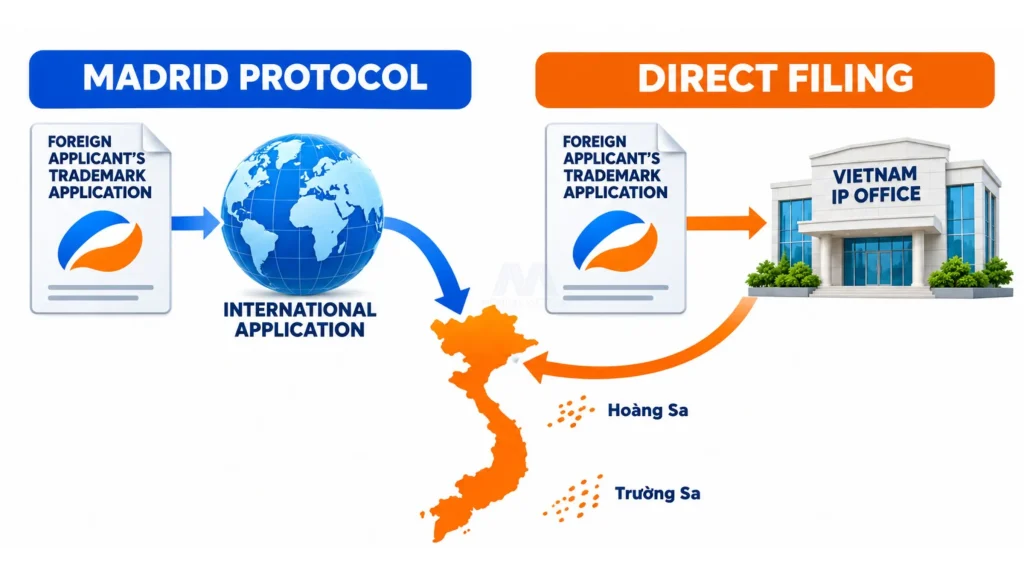
Foreign applicants usually have two main options to seek trademark protection in Vietnam: filing through the Madrid Protocol by designating Vietnam, or filing a direct national trademark application in Vietnam.
Both routes can be effective. However, they serve different business needs. The right choice depends on the applicant’s market-entry plan, filing budget, trademark portfolio strategy, timeline, and risk profile.
This article compares Madrid Protocol vs direct trademark filing in Vietnam to help foreign applicants choose the most suitable route.
Overview: Madrid Protocol vs Direct Filing in Vietnam
When comparing Madrid Protocol vs direct filing in Vietnam, foreign applicants may protect their trademarks through:
- Madrid Protocol designation of Vietnam;
- Direct national trademark filing in Vietnam.
The Madrid Protocol is an international filing system administered by the World Intellectual Property Organization. It allows eligible trademark owners to file one international application and designate multiple member countries, including Vietnam.
Direct filing, on the other hand, means filing a national trademark application directly in Vietnam through a Vietnam local representative.
The key difference is simple: Madrid is a centralized international filing route, while direct filing is a Vietnam-specific national route.
Madrid Protocol vs Direct Filing in Vietnam: What Is Madrid Protocol Filing?
Madrid Protocol filing allows an eligible applicant to seek trademark protection in Vietnam by designating Vietnam in an international trademark application.
To use the Madrid System, the applicant must have a basic application or basic registration in its Office of origin. For example, a US company may use a US trademark application or registration as the basic mark, while a Japanese company may use a Japanese trademark application or registration.
Through Madrid, the applicant can file one international application, use one language, pay WIPO fees in one currency, and designate multiple countries. Vietnam then examines the designation according to Vietnamese trademark law.
This means Madrid does not guarantee protection in Vietnam. It only provides a route to request protection. Vietnam may still issue a provisional refusal if the mark does not meet local requirements.
Madrid Protocol vs Direct Filing in Vietnam: What Is Direct Trademark Filing?
Direct trademark filing means the applicant files a national trademark application directly with the Vietnamese trademark authority.
For foreign applicants without residence or a business establishment in Vietnam, direct filing is generally made through a lawful representative in Vietnam. In practice, this means working with a Vietnam IP representative or trademark attorney.
Direct filing gives the applicant more flexibility to prepare a Vietnam-specific application. This may be useful where the mark has local language issues, similarity risks, classification concerns, or where Vietnam is a priority market.

Madrid Protocol vs Direct Filing in Vietnam: Key Advantages of Madrid
Madrid Protocol can be a good option for foreign applicants managing international trademark portfolios.
Centralized Filing
The applicant can file one international application and designate several countries. This is efficient when a company wants protection in many markets at the same time.
One Language and One Currency
Madrid filing avoids dealing with different languages and currencies at the initial filing stage. This can reduce administrative complexity for international brand owners.
Centralized Portfolio Management
Changes such as renewal, change of name, change of address, or subsequent designation can often be managed centrally through WIPO.
Cost Efficiency for Multi-Country Filing
If the applicant is seeking protection in many countries, Madrid may be more cost-effective than separate national filings in each country.
Suitable for Global Expansion
Madrid is particularly useful for companies with a structured global trademark portfolio and a clear list of target countries.
Madrid Protocol vs Direct Filing in Vietnam: Key Limitations of Madrid
Although Madrid is convenient, it is not always the best route for Vietnam.
Vietnam Still Examines the Mark Under Local Law
Designating Vietnam through Madrid does not mean automatic registration in Vietnam. The Vietnamese authority still examines the mark based on Vietnamese trademark law and practice. A mark that is accepted in the United States, the EU, Canada, Australia, Japan, or Korea may still face refusal in Vietnam.
Provisional Refusal May Require Local Support
If Vietnam issues a provisional refusal, the applicant may need to appoint a Vietnam representative to respond. At this stage, the applicant may still need local legal arguments, Vietnamese-language filings, amendments, and evidence.
Less Flexibility in Goods and Services
Madrid applications are connected to the basic mark. The scope of goods and services in the international application cannot be broader than the basic application or registration. This may limit flexibility if Vietnam requires a different or more strategic specification.
Dependency on the Basic Mark
An international registration remains dependent on the basic mark for the first five years. If the basic mark is refused, withdrawn, cancelled, or limited during this period, the international registration may be affected. This dependency risk is especially relevant where the applicant uses a pending application as the basic mark rather than a stable registration.
Not Always Ideal for Vietnam-Focused Strategy
If Vietnam is a key market, the applicant may need a more tailored filing strategy than Madrid can provide. This is common for consumer brands, F&B, cosmetics, pharmaceuticals, fashion, franchising, and e-commerce businesses.
Madrid Protocol vs Direct Filing in Vietnam: Key Advantages of Direct Filing
Direct national filing may be preferable when Vietnam is commercially important.
More Local Control
Direct filing allows the applicant and Vietnam representative to prepare the application specifically for Vietnamese examination practice. This includes goods and services wording, trademark presentation, Vietnamese translation, transliteration, classification, and local registrability assessment.
Better for Vietnam-Specific Risk Assessment
Before filing, the applicant can conduct a local trademark search and assess risks based on Vietnamese prior marks and examination practice. This is important because Vietnam generally follows a first-to-file approach. Early and well-planned filing may reduce the risk of later disputes.
Suitable for High-Value Brands
If Vietnam is a priority market, direct filing often provides better strategic control. This is particularly relevant for brands entering Vietnam through distribution, licensing, franchising, manufacturing, e-commerce, or investment.
Direct Handling of Office Actions
If objections arise, the Vietnam representative can directly monitor and respond to office actions, refusals, amendments, and other procedural matters.
No Dependency on a Foreign Basic Mark
Unlike Madrid filing, direct national filing in Vietnam does not depend on the status of a basic foreign application or registration. This may be useful where the applicant’s home-country application is still pending, vulnerable, or narrower than the desired Vietnam filing scope.
Madrid Protocol vs Direct Filing in Vietnam: Key Limitations of Direct Filing
Direct filing also has limitations.
Separate National Filing
The applicant must file and manage a separate application in Vietnam. This may require separate fees, separate documents, and separate docketing.
Local Representative Required
Foreign applicants without a local establishment generally need to file through a lawful representative in Vietnam.
Less Efficient for Many Countries
If the applicant wants protection in many countries at once, separate national filings may be more expensive and administratively complex than Madrid filing.
Comparison Table: Madrid Protocol vs Direct Filing in Vietnam
| Factor | Madrid Protocol Designating Vietnam | Direct Trademark Filing in Vietnam |
|---|---|---|
| Best for | Multi-country trademark strategy | Vietnam-focused protection |
| Filing system | Centralized international route | National filing route |
| Initial administration | Simpler for many countries | Separate Vietnam filing |
| Local flexibility | More limited | Higher |
| Goods/services scope | Linked to basic mark | Vietnam-specific drafting possible |
| Local representative | Often needed if refusal arises | Generally required for foreign applicants without local establishment |
| Basic mark dependency | Yes, during the first five years | No |
| Cost advantage | Better for multi-country filing | Better for focused local strategy |
| Suitable when | Vietnam is one of many target markets | Vietnam is a priority market |
| Risk handling | Local support may be needed later | Local support from the beginning |
Madrid Protocol vs Direct Filing in Vietnam: Which Route Should Foreign Applicants Choose?
The best route depends on the applicant’s commercial and legal priorities.
In Madrid Protocol vs direct filing in Vietnam, choose Madrid Protocol if:
- you are filing in many countries at the same time;
- Vietnam is one of several target markets;
- your basic mark is stable and properly drafted;
- your goods and services are consistent across jurisdictions;
- you want centralized portfolio management;
- your mark has low refusal risk in Vietnam.
Madrid may be a practical option for companies with an established international portfolio and a clear global trademark strategy.
In Madrid Protocol vs direct filing in Vietnam, choose direct filing if:
- Vietnam is a key market;
- you plan to appoint a distributor, franchisee, licensee, or manufacturer in Vietnam;
- you need a Vietnam-specific trademark search;
- your mark includes local language, translation, or transliteration issues;
- your goods/services require careful drafting;
- your home-country mark is still pending or vulnerable;
- you want direct support from a Vietnam trademark representative from the beginning.
Direct filing may be more appropriate when trademark protection in Vietnam is commercially important and requires local legal control.

Practical Examples of Madrid Protocol vs Direct Filing in Vietnam
Example 1: US Company Expanding to 10 Countries
A US technology company plans to register the same mark in 10 countries, including Vietnam. Its US registration is stable, and the goods/services are consistent. Madrid designation may be efficient However, the company should still conduct a Vietnam search before designating Vietnam to assess local refusal risks.
Example 2: Japanese F&B Brand Entering Vietnam Through Franchise
A Japanese F&B brand plans to license its brand to a Vietnamese franchise partner. Vietnam is a priority market, and the brand may use English, Japanese, and localized Vietnamese elements. Direct filing in Vietnam may be more suitable because local control is important.
Example 3: EU Cosmetics Brand Facing Distributor Risk
An EU cosmetics brand is negotiating with a Vietnamese distributor. Because distributor-related trademark risks are common in cross-border expansion, direct filing before signing the distribution agreement may be the safer approach.
Recommended Approach to Madrid Protocol vs Direct Filing in Vietnam
In Madrid Protocol vs direct filing in Vietnam, foreign applicants should not choose the filing route based only on filing fees. The better question is:
“Which route gives the applicant stronger, faster, and more practical protection for its Vietnam business plan?”
For some applicants, Madrid is efficient and commercially reasonable. For others, especially those treating Vietnam as a key market, direct national filing may provide better control and lower practical risk. In many cases, the best first step is to conduct a Vietnam trademark search and obtain a local filing strategy before deciding between Madrid and direct filing.
How Monday VietNam Advises on Madrid Protocol vs Direct Filing in Vietnam
Monday VietNam assists foreign applicants, trademark attorneys, law firms, exporters, franchisors, distributors, manufacturers, and investors with trademark protection in Vietnam.
Our services on Madrid Protocol vs direct filing in Vietnam include:
- Vietnam trademark availability search;
- Madrid vs direct filing strategy;
- direct national trademark filing in Vietnam;
- Madrid provisional refusal handling;
- office action response;
- opposition and cancellation support;
- trademark renewal, assignment, and licensing recordal;
- coordination with foreign counsel and in-house legal teams.
FAQ: Madrid Protocol vs Direct Filing in Vietnam
1. Madrid Protocol vs direct filing in Vietnam: which is cheaper?
Madrid may be more cost-effective when filing in multiple countries. However, if Vietnam issues a provisional refusal, additional local fees may arise. For Vietnam-focused protection, direct filing may be more practical.
2. Does Madrid Protocol guarantee trademark protection in Vietnam?
No. Vietnam still examines the designation under Vietnamese law and may issue a provisional refusal.
3. Do foreign applicants need a Vietnam representative?
For direct national filing, foreign applicants without a residence or business establishment in Vietnam generally need to file through a lawful representative in Vietnam. For Madrid cases, local representation may be needed if a refusal or local proceeding arises.
4. Can I file directly in Vietnam if I already used Madrid?
Yes. Depending on the case, a direct national filing may still be considered, especially for additional marks, localized versions, broader strategy, or risk management.
5. Madrid Protocol vs direct filing in Vietnam: which route is better for a distributor or franchise arrangement?
Direct filing is often preferable when the applicant is entering Vietnam through a distributor, licensee, franchisee, or local manufacturing partner, because early local control of the trademark is important.
Contact Monday VietNam About Madrid Protocol vs Direct Filing in Vietnam
If you are unsure about Madrid Protocol vs direct trademark filing in Vietnam, contact Monday VietNam for a Vietnam trademark search, filing strategy, and clear quotation before proceeding.
Start your Vietnam trademark registration today. Email mdvn@mondayvietnam.com or call/Zalo +84 86 200 6070 for an initial assessment. Our team will review your mark, recommend direct filing or Madrid designation, and quote transparent fees with no hidden costs.

Quý khách cần tư vấn về Sở hữu trí tuệ & Pháp lý cho doanh nghiệp?
Monday VietNam cung cấp giải pháp pháp lý toàn diện cho doanh nghiệp, từ bảo hộ tài sản trí tuệ, pháp lý quản trị nội bộ, pháp lý tuân thủ, lao động nhân sự và giải quyết tranh chấp...
📞 Hotline: 086 200 6070
📧 Email: mdvn@mondayvietnam.com
* Miễn trừ trách nhiệm: Nội dung bài viết mang tính tham khảo, không thay thế ý kiến tư vấn pháp lý chính thức và không làm phát sinh quan hệ tư vấn giữa người đọc và Monday VietNam. Do quy định pháp luật có thể thay đổi và việc áp dụng phụ thuộc vào từng trường hợp, doanh nghiệp nên liên hệ Monday VietNam để được tư vấn cụ thể.
* Lưu ý: Hình ảnh trong bài viết có sự tham gia của AI